Home / About
A yard built around the tote.
IBC Columbus started in 2019 with two pallets, one pickup, and a stubborn idea: every used IBC tote in the Upper Midwest deserves a second buyer before it ever sees a grinder.
Skip the story — get a quote.
If you're here to buy or sell, you can do that right now. The story can wait.
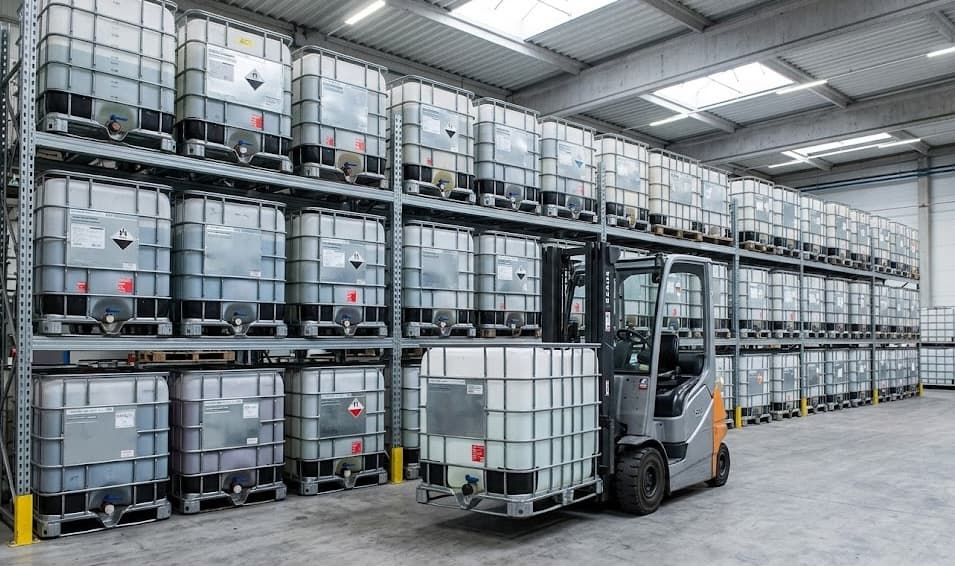
The short version
Our founder, a former chemical-distribution dispatcher, kept watching pristine intermediate bulk containers get crushed at the back gate of the same warehouses he was delivering to. The math was painful: a tote that cost $300 new was being scrapped for pennies after a single fill, then replaced — also for $300 — with a fresh one barged in from the Gulf coast. So in October 2019, with a borrowed flatbed and a hand-painted sign reading "$40 per tote, cash today", the yard opened.
Today we move thousands of totes a year, run a real reconditioning line, operate our own plastic recycling stream for end-of-life bottles, and keep one foot firmly in the neighborhood: every truck driver, washer, fabricator and dispatcher lives within twenty minutes of the yard.
Timeline
- 2019Yard opens at 2011 Hendrix Dr in Grove City with one pickup and a hand-painted sign.
- 2020First reconditioning line installed — caustic wash, cage straighten, leak test.
- 2021Logistics team grows to four trucks; pickup radius expands to IN, KY, WV, PA.
- 2022FDA-grade segregation protocol formalized. Begin certifying food-grade reconditioned totes.
- 2023On-site granulator added — end-of-life bottles ground and pelletized in-house.
- 2024Custom fabrication shop opens. First IBC-to-aquaponics conversion ships.
- 2025Reclaim Counter launched. Sustainability report is now public and audited yearly.
- 2026Begin building Tote-Loop, our regional return-network for soap and beverage co-ops.
What you'll find when you visit
The yard
About 1.4 acres of fenced gravel, sorted by grade: food, industrial, rebottled, raw, and end-of-life. Walk it any weekday morning.
The wash bay
A two-bay heated bay with closed-loop water reclaim — we filter and reuse 92% of our wash water, and we'll show you the meter.
The fab shop
One welder, one CNC, one ridiculously over-engineered cutting jig built from a forklift mast. Custom fittings happen here.
The decisions that mattered most
If we had to pick the five operating decisions that turned a one-pickup yard into what we are now, these would be them.
Build the wash bay before scaling sales.
We could have grown faster by buying and re-selling without reconditioning. Instead we put almost all of year-two profit into a real heated wash bay. Without it, we'd have been a broker; with it, we're an operator.
Formalize the food-grade segregation protocol.
Until 2022 we washed everything the same way and called the cleanest ones food-grade. The new protocol — separated wash runs, batch logs, sampled rinse — was painful at first and is now the foundation of our pharma and brewery business.
Bring the granulator on-site.
We used to ship end-of-life bottles to a third-party recycler. Bringing the granulator in-house meant we could trace every kilogram of regrind to a North-American molder. The Reclaim Pledge wouldn't be defensible without this.
Open the fab shop.
For years customers asked us to modify totes for hydroponics, biochar, sap evaporation. We always said "we're a wash yard, not a fab shop." Then we hired a welder and built a CNC bench, and we never looked back. The fab shop is a small revenue line and a huge customer-loyalty driver.
What hasn't changed
- One yard. No second location, no franchise model, no satellite warehouses. Density beats sprawl.
- Email-first. No phone, no chatbot, no live-chat widget. Just email to a small inbox staffed by humans.
- Posted prices. We've published our reconditioned-tote price ranges since year one. Volume tiers, no haggling.
- Local hiring. Every employee lives within 20 minutes of the yard. We're a Grove City employer; we want the team here.
- Honest annual report. The Sustainability Report doesn't dodge the misses. Diesel fleet, gas-fired wash water — both still on the to-fix list.
What we get asked about most
Are you part of a chain or franchise?
No. We're a single, independent yard at one address in Grove City, Ohio. Some other "IBC" companies are franchises or marketing fronts for distant operators. We're not.
Are you for sale?
No, and we don't intend to be. The yard is profitable, the team is paid well, and we'd rather grow density at one location than be acquired and folded into a national rollup.
Why "Columbus" if you're in Grove City?
Grove City is part of the Greater Columbus metro — about 15 minutes south-west of downtown. Naming is for the regional identity, not strict municipality. Customers find us by metro.
Do you have a phone number?
No. We've never had one and we don't plan to. Voicemail tag costs us hours; email costs us minutes. Every email goes to a real inbox; we reply within one business day.